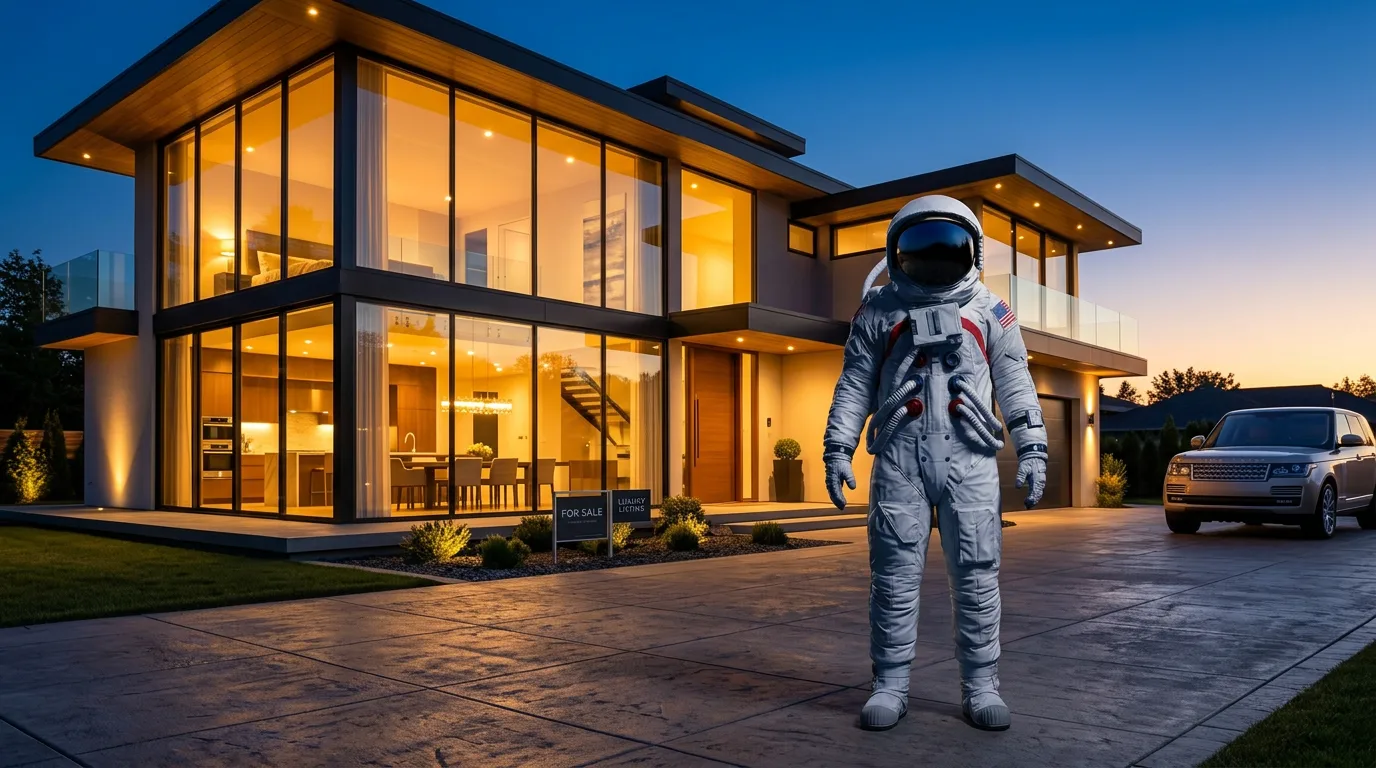
Luxury Real Estate Marketing That Earns the Listing and the Buyer
A luxury home is sold over weeks, not minutes, to a buyer who pays cash and refuses to compromise. We build the search, AI, and presentation presence that makes your listings the ones affluent buyers self-select into before they ever call.
Luxury real estate is its own marketing discipline. The buyer is rate-immune, the sales runway is long, the inventory is rising, and presentation is the lever, so you win on differentiated, sustained marketing and reputation, not on who pushes the most leads.
The affluent buyer behaves nothing like the median one. Redfin pegs the typical luxury home at a $1,278,950 median price in October 2025, with luxury prices rising 5.5% year over year against 1.8% for everything else, roughly three times the pace. That buyer often pays cash, takes their time, and tours the home on video long before a showing. The decision is slower, more deliberate, and more presentation-driven than a starter-home sale.
That is why a generic real estate playbook underperforms at the top of the market. The runway is longer (58 days on market for luxury versus 45), supply is loosening (luxury inventory up 6.4% year over year to a five-year high), and the failure points are specific: thin video, no aerial imagery, a listing the AI answer skips, a referral that gets out-vetted online. We build around those exact moments, and every claim on this page is backed by a real source, listed at the bottom.
The case for doing this differently is not our opinion. It is what the data says, every figure sourced below.
The luxury market is pulling away from everything else.
The top of the housing market is on its own trajectory. Redfin reports luxury home sale prices rose 5.5% year over year to a median $1,278,950 in October 2025, a record high for the month, while non-luxury prices rose just 1.8%. Luxury is growing roughly three times faster than the rest of housing, and Coldwell Banker’s 2026 data shows single-family luxury prices up 3% in 2025 with sales up 4%.
For an agent or brokerage at this tier, that gap is the opportunity and the trap. Demand is resilient and values are climbing, which draws more competitors into the same listings. Marketing that simply chases volume misreads the market; the win is owning the high-intent search and AI surfaces for your specific markets and price bands, so the buyers already moving find your inventory first.
Luxury prices are rising roughly three times faster than the rest of housing. The market that holds up is the one worth competing for.
Two markets moving at different speeds
Luxury home prices hit a record median of $1,278,950 in October 2025.
Source: Redfin, U.S. Luxury Home Prices Jump 5.5% in October 2025Your buyer doesn’t care what mortgage rates do.
The affluent buyer is largely insulated from the rate cycle that sidelines the rest of the market. In Coldwell Banker’s 2025 mid-year report, 96% of Global Luxury Property Specialists said luxury buyers are maintaining or increasing their use of cash purchases, and 51% reported an outright increase in all-cash transactions. When the rest of the funnel freezes on rate news, luxury demand holds.
That changes the marketing job. You are not nurturing a rate-anxious buyer toward a financing decision; you are reaching someone with liquidity, conviction, and a refusal to settle. Coldwell Banker found 30% of specialists named a “no-compromise” mindset the top current trend, with buyers unwilling to give on lifestyle, condition, or features. The work is precise matching and presentation that meets that standard, not lead-volume tactics built for a price-sensitive market.
Liquid buyers, immune to the rate cycle
And 51% report an outright increase in all-cash transactions.
Source: Coldwell Banker Real Estate, Mid-Year Luxury Report (PR Newswire, 2025)A luxury listing is a marketing campaign, not a quick flip.
Luxury homes sell on a longer, calmer clock. Redfin found the typical luxury home took 58 days to sell in October 2025 versus 45 for non-luxury, and only 26.7% of luxury listings went under contract within two weeks, against 31.3% for the broader market. At the same time, the number of luxury homes for sale rose 6.4% year over year to a five-year high, so more inventory is competing for the same affluent buyers.
That math rewards sustained, differentiated presentation over a burst of leads. A listing that needs to hold demand for two months in a crowded field cannot run on a quick-hit campaign that peaks and fades in week one. We build marketing that compounds over the full listing cycle: durable search and AI visibility, a presentation package that keeps drawing qualified interest, and reporting tied to showings and offers, not first-week click spikes.
Most luxury homes are still being marketed after two weeks
Affluent buyers tour your home on video before they ever call.
At this price point, the property sells itself online first or not at all. Per NAR and Google research, 70% of buyers use video to tour the inside of a home and 86% use video to learn about a community, and agent-related searches on YouTube climbed 46% year over year. A luxury listing without strong video is invisible at the exact research stage where these buyers self-select. Aerial imagery matters just as much: NAR reports that, per the MLS, homes shown with aerial shots are 68% more likely to sell, and estates, acreage, and views are precisely what define this tier.
This is the highest-leverage place to differentiate, because most listings still treat video and drone as an afterthought. We build presentation as the core asset, not a checkbox: cinematic walkthroughs, aerial that frames the land and setting, and pages structured so that video, imagery, and the location story are indexed and surfaced by search, YouTube, and the AI answer layer. When the buyer is deciding which homes to even visit, presentation is what earns the showing.
70% of buyers tour the inside of a home on video, and 86% research the community there. Presentation is where the buyer self-selects.
The media that earns the showing
The luxury buyer pool is changing under your feet.
A generational handoff is reshaping who buys at the top. Coldwell Banker’s 2026 Trend Report projects nearly $2.4 trillion in US real estate, 52% of all global luxury property expected to transfer, will change hands over the next ten years, with buyers worth $5M to $30M driving 65.7% of US property wealth transfers. Investment is accelerating at the very top, too: since 2020, luxury real estate investment is up 59.9% among buyers with more than $5 million in net worth.
Those emerging heirs and high-net-worth buyers are digital-first. They research on video, read reviews, and form opinions through search and AI long before a referral turns into a call. Even a warm introduction gets vetted: BrightLocal finds 97% of consumers read reviews for local businesses and 49% trust online reviews as much as a personal recommendation, with 71% reading them on Google. Positioning for this buyer means building the digital reputation and discoverability they expect, not relying on a referral network calibrated to the last generation.
A wealth transfer reshaping the buyer pool
Buyers worth $5M to $30M will drive 65.7% of US property wealth transfers.
Source: Coldwell Banker Global Luxury, 2026 Trend Report (PR Newswire)Paid is a premium play, and the competition is global.
At the top, the field is wider and the buyer is global. A luxury Google Ads program has to win on tight geo and intent targeting, not budget, because the competition is not just local: Knight Frank recorded 555 sales of US$10 million-plus homes in Q4 2025 across its 12 tracked markets, totaling US$10.3 billion and up 17% quarter over quarter. At the ultra tier, your listing competes with cities worldwide for the same buyer.
Spending more is not a strategy when everyone can buy the click. The durable edge is organic and AI visibility, which still drives the majority of discovery: BrightEdge data puts organic search at 53% of trackable website traffic versus about 15% for paid. That moat is under pressure, though. Pew Research found that when Google shows an AI summary, searchers click a traditional result only 8% of the time versus 15% with no summary, so the firms that win are structured to be the answer the AI assembles, not just a link below it. We point spend at the moments that convert and build the organic and AEO presence that keeps working after the campaign ends.
Nearly $2.4 trillion in U.S. real estate, or 52% of all global luxury property expected to transfer, will change hands in the next ten years. Individuals with $5 million to $30 million in net worth will drive 65.7% of U.S. property wealth transfers.
Coldwell Banker Global Luxury, 2026 Trend Report
Despite ongoing economic uncertainty, 96% of Coldwell Banker Luxury Property Specialists report luxury buyers are maintaining or increasing their use of cash purchases. Another 51% of those surveyed report an increase in all-cash transactions, signaling a shift among affluent home buyers toward leveraging liquid funds over elevated borrowing costs.
Coldwell Banker Real Estate, Mid-Year Luxury Report (2025)
Google users were less likely to click on result links when visiting search pages with an AI summary compared with those without one.
Athena Chapekis, Data Science Analyst, Pew Research Center
Frequently asked
Is luxury real estate marketing really different from standard real estate marketing?
How important is video and drone footage for selling a luxury home?
Does paid search work for luxury listings?
Why does my marketing need to address AI search and not just Google rankings?
My business is mostly referrals. Do I still need a strong online presence?
How do you measure success on a luxury real estate marketing program?
Ready to own the buyers your listings deserve?
If your inventory sits at the top of the market, your marketing should reach the buyer who pays cash, tours on video, and won’t compromise. We build the presentation, search, AI, and reputation presence that makes your listings the ones affluent buyers find and trust first, then we report on showings and offers, not vanity traffic. Tell us your markets and price bands, and we’ll show you exactly where the high-intent demand is and how to win it.
Every figure on this page comes from a primary platform, an independent study, or a named industry source. No competing-agency stats, no made-up numbers.
- Redfin, U.S. Luxury Home Prices Jump 5.5% in October 2025
- Coldwell Banker Real Estate, Mid-Year Luxury Report (PR Newswire, 2025)
- Coldwell Banker Global Luxury, 2026 Trend Report (PR Newswire)
- NAR and Google, Real Estate in a Digital Age (via Union Street Media)
- National Association of REALTORS, Drones
- Knight Frank, Global Super-Prime Intelligence Q4 2025
- BrightEdge Research, organic share of traffic
- Pew Research Center, AI summaries and click-through, 2025
- BrightLocal Local Consumer Review Survey