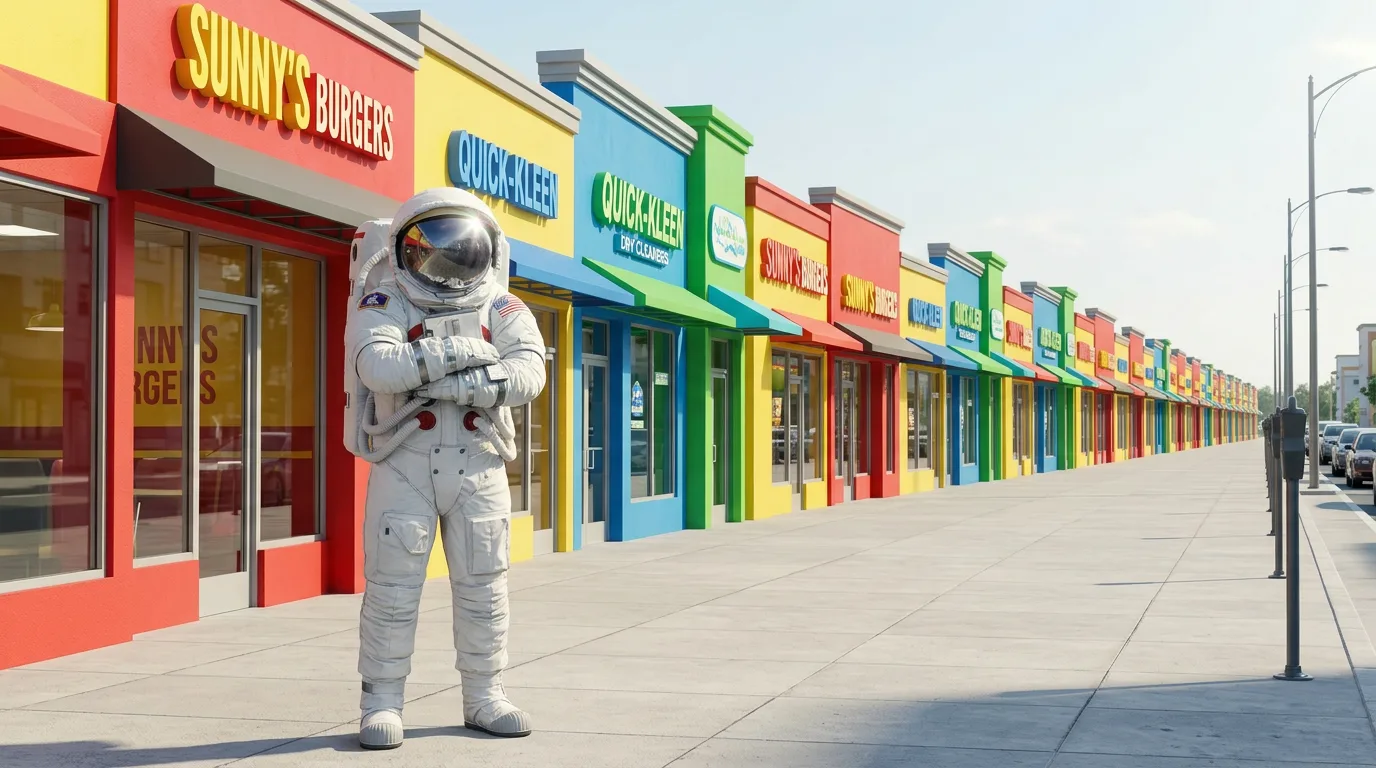
Multi-Location Marketing for Chains and Franchise Brands
A chain doesn’t have one marketing problem; it has hundreds of them, one per location, all wearing the same logo. We build the local search, AI, and reputation presence that makes every site findable and every brand standard hold at scale.
Multi-location marketing is won at the location level and lost in the gaps between locations: the missing map listing, the stale hours, the store with eleven reviews next to the one with four hundred. Brand awareness fills the funnel, but local execution is what converts it, store by store.
When someone searches for what you sell, they aren’t looking for your brand in the abstract. They’re looking for the nearest open location that other people trust, and the decision happens in the map pack and the AI answer before anyone reaches your homepage. A national campaign can build the name, but if the listing for store #47 has the wrong hours and no recent reviews, that store loses the customer to a competitor three blocks away. The brand pays for demand; the location either captures it or leaks it.
That is why generic “franchise marketing” underperforms here. The work isn’t one big campaign, it’s a system that keeps every location accurate, visible, and reviewed, enforces brand standards without flattening local nuance, and stays measurable across a footprint that grows every quarter. We build around the two audiences this niche serves, the customers each location needs and the operators the brand recruits, and every claim on this page traces to a real source listed at the bottom.
The case for doing this differently is not our opinion. It is what the data says, every figure sourced below.
A few operators now run most of your locations.
The shape of franchising has shifted, and it changes who you market to and through. As of 2025, only 19.3% of franchisees operate multiple units, yet that group controls 58.8% of all franchised locations. The system is consolidating into the hands of sophisticated multi-unit operators who run portfolios, not single stores, and who expect marketing that scales across every site they own.
That reality cuts two ways. For the brand, it means local marketing has to work as a repeatable system a multi-unit operator can trust across ten or fifty locations, not a bespoke project per door. For franchise development, it means the most valuable recruit is an operator who can open several units, and they vet a brand on whether its marketing engine reliably drives customers to each one. Either way, the lever is the same: a local program that performs the same in every market, at scale.
Under a fifth of franchisees control nearly 59% of locations. You market through operators who run many sites at once.
Most locations sit with multi-unit operators
Most chains show up for their own terms one time in three.
Local visibility is the core battleground for any multi-location brand, and most are leaving it on the table. SOCi’s 2026 Local Visibility Index found that across multi-location brands, the average appearance rate in Google’s local 3-pack for priority terms is just 35.9%. For roughly two of every three high-intent local searches a chain should win, it isn’t even in the box where the click happens.
That gap is pure leaked demand, and it compounds across a footprint. The map pack matters because 42% of searchers click a result inside it on local queries, so missing it isn’t a soft branding loss; it’s a customer walking into a competitor. We close the gap the way it has to be closed at scale: clean, complete, and consistent location data, a Google Business Profile managed per site, local landing pages built to rank, and a review engine feeding each listing the signals Google rewards.
The local searches most chains miss
AI assistants recommend almost none of your locations.
The local decision is moving into AI answers, and the funnel there is far narrower than anything chains are used to. In the same SOCi study, spanning more than 350,000 locations across 2,751 multi-location brands, ChatGPT recommended just 1.2% of brand locations; Gemini surfaced 11% and Perplexity 7.4%. When a customer asks an assistant where to go, almost no one’s locations are in the answer, and the cost of being absent is the whole sale.
It would be convenient if a strong Google presence carried over, but it doesn’t. SOCi estimates AI visibility is three to thirty times harder to achieve than ranking in traditional local search, and in retail fewer than half of the brands that lead in Google local visibility also rank among the most AI-recommended. AI is a present-tense factor, not a future one: 18% of Google searches already return an AI summary. Winning it is its own discipline, structured entity data, consistent location facts, and content built to be quoted, and we manage both surfaces deliberately rather than assuming one feeds the other.
ChatGPT recommends 1.2% of brand locations. AI visibility is three to thirty times harder than ranking in local search.
AI assistants surface a sliver of locations
And only 1% of searchers click a link inside a Google AI summary when one appears.
Source: SOCi, 2026 Local Visibility IndexEvery location lives or dies on its own reviews.
A customer doesn’t choose your brand; they choose a specific location, and they choose it on reviews. BrightLocal’s 2026 survey found 97% of consumers read reviews for local businesses, and 71% read them on Google. For a chain, that means reputation isn’t one corporate score; it’s the star rating and review volume of each individual store, and a single neglected location quietly drags down trust in the whole market around it.
The hard part is consistency across the footprint. One store earns reviews steadily while the one across town never asks, and the gap shows up in the map pack and the customer’s decision. We run reputation as an owned, per-location system: a steady, on-brand engine for earning reviews, responses that meet brand and compliance standards, and reporting that surfaces the laggard stores before they cost the brand customers. The goal is that every location, not just the flagship, looks like a place people trust.
Reviews drive the location-level decision
The demand is high-intent. Slow follow-up wastes it.
Location-level demand converts when it’s caught fast. In home services, a major franchise category, paid search runs a 7.33% conversion rate at a $7.85 average cost per click and a $90.92 cost per lead in 2025. Those are workable economics, but only if the lead is worked the moment it lands. The MIT and InsideSales lead-response research found the odds of qualifying a lead drop 21-fold when response time slips from five minutes to thirty, and a centralized brand campaign that hands leads to locations that answer hours later is paying full price for inquiries it then lets cool.
So the spend is only half the equation; the handoff is the other half. We build location-level demand and the intake discipline to convert it: tracked routing to the right store, fast response standards, and reporting on booked jobs and qualified leads rather than clicks. The customer you already paid to reach is the cheapest one you’ll ever convert, and at chain scale, a few points of speed-to-lead across every location is a meaningful number.
What a slow callback costs
Home-services paid search converts at 7.33% on a $90.92 cost per lead, but only when the lead is worked fast.
Source: MIT (Dr. James Oldroyd) & InsideSales Lead Response Management StudyRecruiting the next operator keeps getting more expensive.
Growth means recruiting operators to open the next locations, and that cost is climbing fast. The Annual Franchise Development Report shows the price to secure each new franchisee rose from $13,757 in 2024 to $17,550 in 2025, roughly a 28% increase in a single year. When the cost of a sale jumps like that, marketing efficiency stops being a nicety and becomes the difference between profitable expansion and a stalled pipeline.
The data also points to where that budget works hardest. Digital marketing is the core of recruitment at about 29% of development spend with a 20% close rate, while the brand’s own development website takes only 10% of spend and closes 22% of its leads, the highest rate in the mix. The lesson is to drive qualified development demand and then convert it on your own site, not bleed it to portals. We build the development funnel the same way we build the local one: efficient demand, a brand site engineered to close, and reporting tied to signed operators, not raw inquiries.
Your own site closes recruits best
AI has collapsed the local decision journey. Consumers aren’t scrolling through options anymore. They’re asking AI to decide for them, and the cost of invisibility has never been higher.
Monica Ho, Chief Marketing Officer, SOCi
Even in a world where people are more aware and more frustrated by the scourge of fake reviews, 97% of consumers still lean on reviews to guide their purchase decisions.
Myles Anderson, Co-founder and CEO, BrightLocal
After a year of recalibration, franchising is better positioned to navigate an improving economic environment than independent businesses due to tax certainty, lower interest rates and investments in AI.
Matt Haller, President and CEO, International Franchise Association
Frequently asked
What is multi-location marketing for a chain or franchise brand?
Why isn’t our brand recommended by ChatGPT or other AI assistants?
We already rank well on Google. Doesn’t that cover AI search?
How important are reviews for each individual location?
What do paid-search leads cost at the location level, and why does response speed matter?
How does this help us recruit new franchisees, not just customers?
Ready to make every location findable?
If your brand fills the funnel but your locations leak it, the fix isn’t a bigger campaign; it’s a local system that performs the same in every market and scales as you grow. We run local SEO, AI visibility, reputation, and paid demand as one program across your whole footprint, with reporting tied to booked customers and signed operators. Tell us your footprint and your growth plan, and we’ll show you where the visibility and conversion gaps are by location.
Every figure on this page comes from a primary platform, an independent study, or a named industry source. No competing-agency stats, no made-up numbers.
- FRANdata, U.S. Franchising’s Economic Outlook in 2026 (multi-unit operator share)
- International Franchise Association, 2026 Franchising Economic Outlook
- SOCi, 2026 Local Visibility Index
- BrightLocal Local Consumer Review Survey 2026
- BrightLocal Local SEO Statistics (map pack CTR, citing Backlinko)
- LocaliQ, 2025 Home Services Search Advertising Benchmarks
- MIT (Dr. James Oldroyd) & InsideSales Lead Response Management Study
- Pew Research Center, Google AI summaries study (2025)
- Annual Franchise Development Report, via Franchising.com (2026)