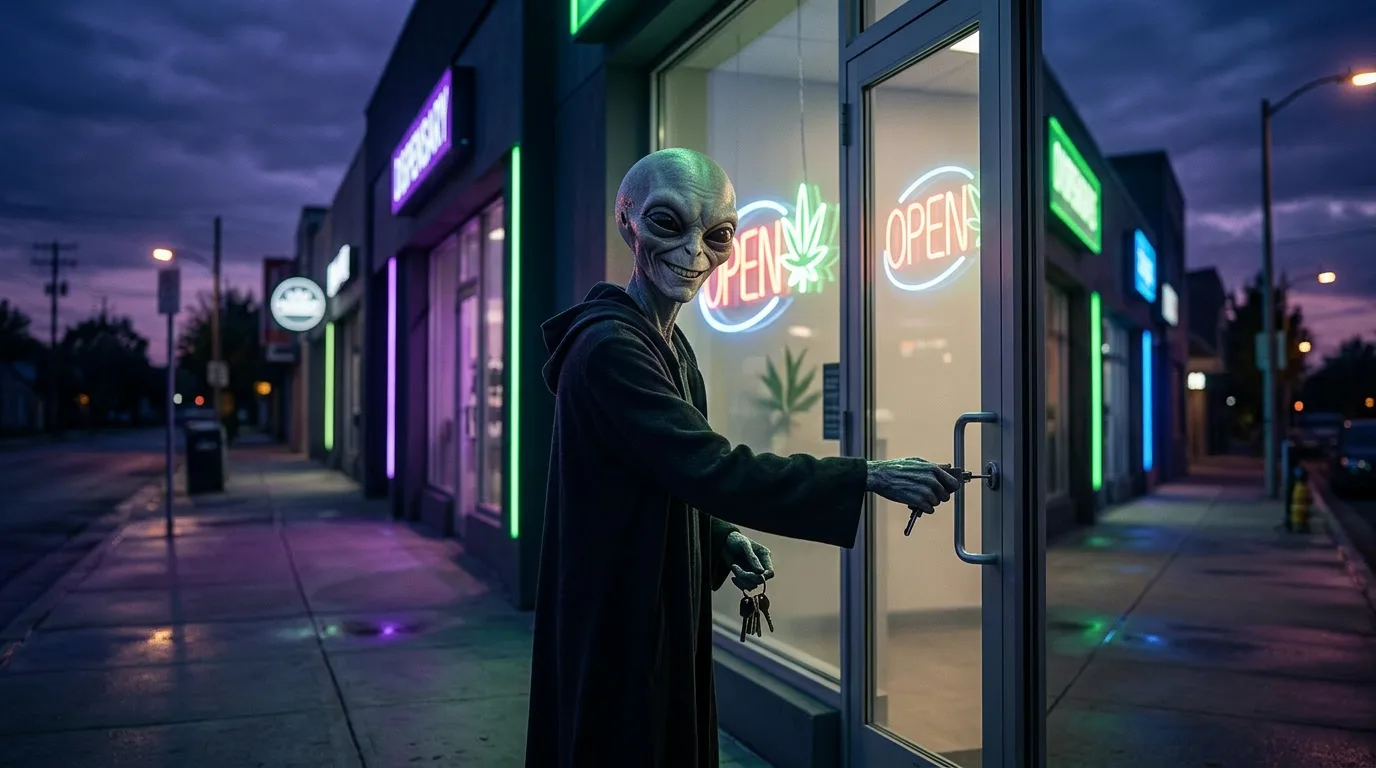
Dispensary Marketing That Owns the Neighborhood, Not Just the Menu
A dispensary lives or dies on who shows up when someone nearby searches “dispensary near me,” and paid search is closed to you by policy. We build the local, organic, and owned-channel presence that wins that neighborhood instead of renting it.
Dispensary marketing is its own discipline because the usual shortcut is gone. Google and the major engines ban cannabis ads, so there is no paid auction to buy your way into. Demand is enormous and local, the win is the map pack and the indexed menu, and the whole point is organic, reputation, and retention.
Someone shopping for a dispensary is not browsing the country, they are looking at their own block. There are nearly 15,000 dispensaries in the US and 79% of Americans now live in a county with at least one, so the fight is hyper-local: which store owns the three-pack, the reviews, and the online menu for one neighborhood. That is a winnable fight, but it runs on different signals than a national ecommerce play.
This is also why a generic “run some ads” approach fails here. The core transactional terms carry no functioning paid auction (cost-per-click comes back null on “dispensary near me” and its category variants), so spending more is not even an option, let alone a strategy. The lever is being genuinely findable, credible, and easy to order from when intent strikes. Every claim on this page is backed by a real source, listed at the bottom.
The case for doing this differently is not our opinion. It is what the data says, every figure sourced below.
“Dispensary near me” is one of the largest local queries in the country.
Cannabis discovery is built almost entirely on “near me” search, and the volume is enormous. “Dispensary near me” pulls 1,580,000 US searches a month at a keyword difficulty of just 12 out of 100, and it surfaces a Google map pack every time. The near-variants sit right behind it: “dispensaries near me” adds 219,000 a month at a difficulty of 17, and the broad head term “dispensary” itself clears 226,000 a month at difficulty 16. Longer category phrases carry real volume too (“cannabis dispensary near me” at 106,000 and “recreational dispensary near me” at 71,000), though those competitive variants run a higher difficulty.
This is not a fad spike either. Monthly volume for “dispensary near me” has held in roughly the 1.4M to 2.2M range for the past three years, peaking at 2,208,000 in July 2023. The intent is durable, year-round, and winnable on the head terms: high volume, low difficulty, local pack attached. Map-pack visibility is the single biggest lever a dispensary has, and it is the work we point at first.
1.58M monthly searches for “dispensary near me,” at a keyword difficulty of 12. High demand, low barrier, local pack attached.
How much “near me” demand is out there
Paid search is closed to you, so organic is the entire point.
Here is the fact that should shape your whole budget: Google Ads policy prohibits ads for substances that alter mental state for recreation, which structurally locks dispensaries out of paid search and paid social. It is not a bidding war you are losing; there is no auction. Cost-per-click returns null on “dispensary near me,” “cannabis dispensary near me,” “recreational dispensary near me,” and “weed delivery near me,” because no functioning paid market exists on the money terms.
For most retailers, paid search is the safety net that buys visibility while organic builds. You do not have that net, which means the channels a generalist treats as optional are your entire acquisition stack: local SEO, the indexed menu, reviews, and owned email and SMS. The data backs the path: word-of-mouth and local SEO together drive 41% of new dispensary customer discovery, the single largest source for a vertical shut out of paid. We build the program that wins on the channels you are allowed to compete on.
Where new customers come from
Your online menu isn’t a convenience, it’s the basket.
The dispensary menu is not a brochure, it is ecommerce infrastructure, and it earns more per order than the counter. About 25% of all cannabis sales now happen online through delivery, curbside, and pickup, and those online orders ring up 35% higher than walk-ins: $68.01 per online order against $50.56 in the store. An indexed, fast, well-structured menu is a basket-size driver, not a nicety.
Shoppers now expect that digital path to exist and to work. In a national survey of cannabis consumers, 75% want simple one-click reordering, 72% want to pre-order online, and 67% call delivery options essential. When the menu is slow, unindexed, or missing those flows, you are not just losing convenience points, you are pushing higher-value baskets to the store down the street that built theirs properly. We treat the menu as the conversion surface it is.
What the online menu is worth
And 25% of all cannabis sales now happen online (delivery, curbside, pickup).
Source: Flowhub, 2026 Cannabis Industry StatisticsYour star rating is the filter before anyone walks in.
Visibility gets you onto the map; reviews decide whether you get the visit. Reviews are a near-universal filter now: 97% of consumers read reviews for local businesses. A minimum bar screens stores out before consideration, 71% of consumers would not consider a business rated below three stars, so a thin or low-rated profile quietly removes you from the running.
Google is where that battle is won, since 81% of consumers use Google to read reviews, well ahead of any other platform, which makes the Google Business Profile your priority reputation surface. Responding is a conversion lever, not housekeeping: 80% of consumers say they are likely to use a business that responds to all of its reviews. We run reviews as an owned asset, a steady, compliant engine for earning and responding to them, so your rating and volume keep pace with the dispensary you are competing against on the same block.
Reviews are effectively the entry filter
The AI answer is starting to take the click.
Search is changing under every dispensary, and the change cuts the traffic informational pages can earn. Pew Research tracked real Google activity and found that when an AI summary appears at the top, people click a traditional result only 8% of the time, against 15% when there is no summary. Roughly 18% of searches produced an AI summary, and 58% of users saw at least one in a single month. Zero-click is already the dominant outcome on Google: 68.01% of US searches ended without any click in the first four months of 2026.
So the goal shifts from ranking beneath the answer to being the source named inside it. For a dispensary, that means structured content, clear local and product entities, and a profile the answer layer can read and cite. Being the cited source in the AI answer and the named store in the map pack matters more than a blue-link position the summary talks over.
AI answers are eating the click
And 68% of US Google searches now end without any click at all (first four months of 2026).
Source: Pew Research Center, 2025In cannabis, loyalty pays back harder than almost anywhere.
Acquisition is only half the equation when paid is closed; keeping the customer is where the math gets good. Loyalty members spend 3.5 times more per year than one-time buyers, so the owned channels you build (email, SMS, and a loyalty program) compound harder in dispensary than in most of retail. And personalization is the hinge that earns that loyalty: 86% of cannabis customers say they would stay loyal to a dispensary that offered them personalized recommendations.
One more thing the marketing buys, the visit, only half-closes the sale on its own. 76% of dispensary shoppers say a budtender’s expertise directly influences what they buy, so the in-store experience finishes what the menu and the map pack start. We build the retention and follow-up infrastructure so the demand you worked to create does not leak out the back.
Consumers are shopping digitally. The purchase journey now often begins online, even when the transaction ends in-store.
Eric Meth, Chief Innovation Officer, Surfside
Reviews are stable, sticky, and more important than ever.
Myles Anderson, Co-founder and CEO, BrightLocal (Local Consumer Review Survey)
Much as it pains me to say, there’s not much point (nor any hope) of fighting back by simply getting better at SEO. Our belief and advice is to invest in Zero Click Marketing: earning influence and growing your brand’s awareness without requiring a visit to your website.
Rand Fishkin, Co-founder and CEO, SparkToro
Frequently asked
What does a dispensary marketing agency do if you can’t run ads?
Why can’t my dispensary just run Google or Facebook ads?
How important is the online menu, really?
Will my dispensary show up in “near me” and map results?
How much do reviews matter for a dispensary?
Is SEO still worth it for a dispensary now that AI answers and zero-click search are growing?
Ready to own your neighborhood’s search, not just your shelf?
Tell us your stores, your markets, and where customers are leaking, and we’ll show you exactly where the local demand is and how we’d win it on the channels you’re allowed to use. Senior people, transparent pricing, and reporting on orders and revenue instead of vanity traffic.
Every figure on this page comes from a primary platform, an independent study, or a named industry source. No competing-agency stats, no made-up numbers.
- Ahrefs Keywords Explorer (US): “dispensary near me” volume, difficulty, local pack, null CPC
- Flowhub, 2026 Cannabis Industry Statistics (online vs walk-in AOV, online share, loyalty, dispensary count)
- Google Ads policy: Dangerous products or services (recreational cannabis ads prohibited)
- mg Magazine, Cannabis Marketing Trends 2026 (word-of-mouth + local SEO discovery share)
- Sweed Cannabis Retail Survey via GlobeNewswire (one-click reorder, pre-order, delivery, budtender influence, personalization loyalty)
- BrightLocal Local Consumer Review Survey (read reviews, respond to reviews)
- BrightLocal Local Consumer Review Survey 2024 (Google as the review platform, below-three-star bar)
- Pew Research Center: clicks when an AI summary appears (2025)
- SparkToro (Rand Fishkin): zero-click search in 2026